3 Open Licenses
Chapter Contents
3.1. Relevant U.S. Copyright Basics
Long before the Internet was conceived, copyright law regulated the very activities the Internet, cheap disc space, and cloud computing make essentially free (copying, storing, and distributing). Consequently, the Internet was born at a severe disadvantage, as preexisting copyright laws discouraged the public from realizing the full potential of the network.
Since the invention of the Internet, copyright law has been strengthened to further restrict the public’s legal rights to copy and share on the Internet (Vollmer, 2015). For example, in 2012 the U.S. Supreme Court upheld the U.S. Congress’s right to extend copyright protection to millions of books, films, and musical compositions by foreign artists that once were free for public use. Lawrence Golan, a University of Denver music professor and conductor who challenged the law on behalf of fellow conductors, academics, and film historians said “they could no longer afford to play such works as Sergei Prokofiev’s ‘Peter and the Wolf,’ which once was in the public domain but received copyright protection that significantly increased its cost” (Barnes, 2012).
U.S. copyright grants a set of exclusive rights to a creator, so that the creator has the ability to prevent others from copying and adapting their work for a limited time. In other words, copyright law strictly regulates who is allowed to copy and share with whom. Copyright law is complex, and varies from country to country, but the basic facts are easy to understand. In the United States, copyright law protects authors’ rights over their original creative works (e.g., research articles, books and manuscripts, artwork, video and audio recordings, musical compositions, architectural designs, video games, and unpublished creative works; 17 USC § 102). As soon as something is “fixed in a tangible medium of expression,” it is automatically protected by copyright. A resource is considered fixed when:
its embodiment … by or under the authority of the author, is sufficiently permanent or stable to permit it to be perceived, reproduced, or otherwise communicated for a period of more than transitory duration. (17 USC § 101)
In other words, an idea for a book you want to write is not protected by copyright, but the outline or first draft of your manuscript is.
Copyright protection ensures that the creator of a work has complete control over how their work is reproduced, distributed, performed, displayed, and adapted (17 USC § 106). You do not need to register your resource with the U.S. Copyright Office for this to come into effect; it is automatic. For more information on copyright law, see Copyright Law of the United States, a useful guide compiled by the U.S. Copyright Office.
3.2. What Are Open Licenses?
The key distinguishing characteristic of open educational resources (OER) is their intellectual property licenses and the legal permissions the licenses grant anyone to use, modify, and share the resource. Unless they are in the public domain (discussed below in Section 3.8), all OER are made available under some type of open license that grants permission for all users to access, reuse, and redistribute a work with few or no restrictions. Open licenses are an integral part of what makes an educational resource an OER. The adaptability and reusability of OER make it so that they are not just free to access, but also free to retain and reuse. Being open is one giant step beyond being free. Some educators think sharing their digital resources online, for free, makes their content OER, but it does not. However, it is OER if they go the extra step and add an open license to their work.
Attribution: “What Is an Open License and How Does It Work” by the Council of Chief State School Officers is licensed under a Creative Commons Attribution 4.0 International License (CC BY 4.0).
3.3. Creative Commons Licenses
Creative Commons (CC) licenses are the most widely used open licenses around the world, and their use is increasing every year. Creative Commons is a nonprofit organization, a set of legal tools, as well as a global network and a movement—all inspired by people’s willingness to share their creativity and knowledge, and enabled by a set of open copyright licenses. These licenses work in parallel with copyright, not separately. An author can retain copyright and license their work with a Creative Commons license. Because definitions of OER place such an emphasis on copyright permissions and licensing, a basic understanding of these licenses is critical to understanding OER.
Creative Commons began in 2001 as a response to what many consider to be an outdated global copyright legal system. CC licenses are built on copyright and are designed to give more options to creators who want to share their work. From the start, CC licenses were intended to be used by creators all over the world. The CC founders—Lawrence Lessig, Hal Abelson, and Eric Eldred—were initially motivated by a piece of U.S. copyright legislation called the Sonny Bono Copyright Term Extension Act enacted in 1998, but similarly restrictive copyright laws all over the world limited how our shared culture and collective knowledge could be used, even while digital technologies and particularly the Internet have opened new ways for people to participate in culture and knowledge production.
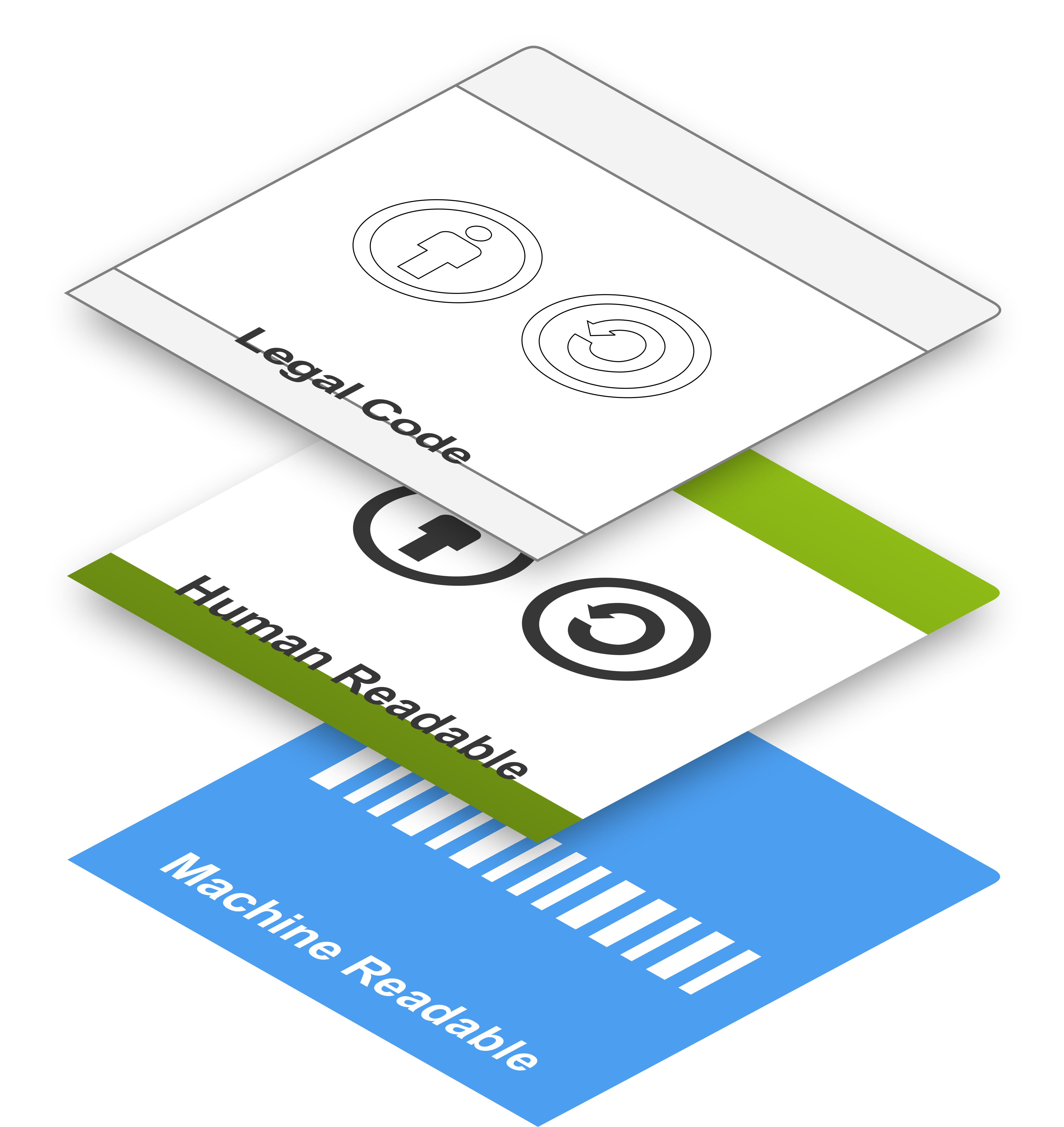
Over time, the role and value of Creative Commons has expanded. Much has changed in the way people share and how the Internet operates. In many countries around the world, the restrictions on using creative works have increased. Yet sharing and remixing are the norm online. In domains like textbook publishing and academic research, restrictive copyright rules continue to inhibit content creation, access, and remixing. CC licenses can help address these issues. They allow content creators to explain, in plain language (with underlying legal muscle), how their creative works can be reused by anyone. The user friendly, public-facing version of the license is known as the Commons Deed, and the underlying legalese is known as the Legal Code. A third layer of the license design is machine-readable code that enables search engines and other software to identify the content as openly licensed.
CC licenses act as explicit, standing permissions for all users, thus eliminating the need for potential users to contact the creator for individual permissions. The licenses were designed to be a free, voluntary solution for creators who want to retain copyright but grant the public up-front permissions to copy, distribute, and make some uses of their works. Although they are legally enforceable tools, they were designed in a way that was intended to make them accessible to non-lawyers.
Around the world, copyright operates by default under an “all rights reserved” approach. CC licenses function within international copyright law, but they use a “some rights reserved” approach. While there are several different CC license options, all of them grant the public permission to use the works under certain standardized conditions. The licenses grant those permissions for as long as the underlying copyright lasts or until the user violates the license terms. Thus CC licenses work like a layer on top of copyright, not instead of copyright (see Figure 3.1).

All CC licenses have some important features in common:
- Every CC license helps creators retain copyright while allowing others to copy, distribute, and make some uses of their work—at least noncommercially.
- Every CC license also ensures licensors get credit (via attribution) for their work.
- Every CC license works around the world and lasts as long as applicable copyright lasts (because they are built on copyright).
These common features serve as the baseline, on top of which authors can choose to grant additional permissions when deciding how they want their work to be used.
The six CC licenses offer a range of options for an author, including limitations on commercial use and derivative works. All the licenses require users of the content to credit or attribute the creator of the material. The four most common CC provisions, by their inclusion, add restrictions to the use of “open” material:
- Attribution (BY) requires any subsequent user, upon publication of the work, to attribute the work to its original author(s).
- The inclusion of the non-commercial clause (NC) prohibits any commercial (as opposed to nonprofit) subsequent user from financially benefiting from the work.
- Prohibiting derivative works (ND; i.e., the original work altered in some way, for instance, translated into another language or “localized” for another country) is a significant departure from some people’s notion of openness.
- Finally, share and share alike (SA) means that if any derivative work or use of the work in another context is accomplished, the new work should be shared with everyone in the same way (that is, with the same restrictions but no more) as the original work.
Each of these provisions, when invoked in a license, may provoke objections from those who advocate openness. Even the strongest advocates of openness will reluctantly accept the attribution provision, because they know how strong and how motivating is the desire for recognition among most authors. But the other provisions present real problems. Even the non-commercial provision, which seems reasonable on the surface, would prevent or deter the propagation of useful material. And there are some internal conflicts in the common CC clauses. Theoretically, for example, you don’t need the share and share alike provision if you prohibit derivative works. More importantly, there is a conflict between the attribution provision and the derivative works provision. If the attribution clause is invoked but then derivative works are permitted, there is the possibility that some objectionable version of the work would bear the original author’s name. This difficulty might be handled by some sort of disavowal clause, but it remains a gray area.
Ultimately, the notion of “open” means freely available on the web for printing, use for any purpose, and carrying the uninhibited right to modify, translate, or repackage. Even a requirement that users register with a website, providing their name and other personal information, inhibits the openness of the material. The addition of restrictions to this vision not only decreases the social utility of open material but seriously obscures the notion of “open,” which is often used to describe even the more restrictive of licenses.
Attribution: “Creative Commons Kiwi” by Creative Commons Aotearoa New Zealand is licensed under a Creative Commons Attribution 4.0 International License (CC BY 4.0).
The licenses, from least to most restrictive, are:
CC BY (Attribution)

This license lets others distribute, remix, adapt, and build upon your work, even commercially, as long as they credit you for the original creation. It is recommended for maximum dissemination and use of licensed materials. This book was created by remixing, adapting, and adding to a variety of CC BY content, and each chapter includes source attributions that credit the authors who made their work open.
CC BY-SA (Attribution-ShareAlike)

This license lets others distribute, remix, adapt, and build upon your work even for commercial purposes, as long as they credit you and license their new creations under the identical terms. All new works based on yours will carry the same license, thus eliminating the possibility that someone will utilize your material and apply a more restrictive license to their version. Wikipedia applies this license to all of its content.
CC BY-NC (Attribution-NonCommercial)

This license lets others distribute, remix, adapt, and build upon your work non-commercially, and although their new works must also acknowledge you and be non-commercial, they don’t have to license their derivative works on the same terms. Authors use this license when they are fine with free reuse, but not commercial uses of their work.
CC BY-NC-SA (Attribution-NonCommercial-ShareAlike)

This license lets others remix, adapt, and build upon your work non-commercially, as long as they credit you and license their new creations under identical terms. Some major players in the world of OER use this license, such as MIT’s OpenCourseWare and the Khan Academy.
CC BY-ND (Attribution-NoDerivs)

This license lets others copy and distribute the work for any purpose, including commercially; however, it cannot be shared with others in adapted form, and credit must be provided to you. Because the ND clause does not allow others to revise or remix your work, this license is not compatible with OER.
CC BY-NC-ND (Attribution-NonCommercial-NoDerivs)

This license allows others to copy your work and share it with others as long as they credit you, but they can’t change it in any way or use it commercially. Because the ND clause does not allow others to revise or remix your work, this license is not compatible with OER.
3.4. Choosing and Using a Creative Commons License
There are a few questions to ask yourself when it’s time to choose a Creative Commons license for your work:
- Do you want to allow people to revise, adapt, or remix your work and share those versions with others?
- Do you want to allow for the possibility of commercial uses of your work?
- Do you want to require people who reuse your work to also share those new versions with a Creative Commons license, thus perpetuating its openness?
Creative Commons provides an easy, step-by-step license chooser on its website. As of this writing, a new license chooser is in beta.
Once you have selected a license, you will need to denote that license in your work. Creative Commons offers downloadable icons on its website, as well as guidelines for adding the license to a variety of formats, including online or offline documents, images, videos, and more. The license should be displayed prominently, such as on the first page of a document or the first slide of a presentation. At a minimum, it should include a link to the full license text on the Creative Commons website. Ideally, it should also include any information that you would want to have users include in a source attribution, such as author name(s), title, and publication date (if applicable).
It is important to note that the CC licenses cannot be revoked. Although you can change your mind and apply a different license to your material at any point, anyone who accessed the material with the previous license is entitled to rely on the terms of that previous license. So, for example, if I published this guide with a CC BY license but later decided to put a more restrictive license on it, such as CC BY-NC, if a commercial publisher had already discovered the guide and made a copy of it while it was CC BY, they could use that copy under the terms of that license.
It is also important to keep in mind that the two most restrictive licenses, CC BY-ND and CC BY-NC-ND, do not allow your content to be revised or remixed. Thus this will preclude the work’s use as true OER, though users will be able to retain, reuse, and redistribute copies of it (noncommercially, in the case of the latter license).
3.5. Using and Attributing Openly Licensed Material
You can use CC-licensed materials as long as you follow the license conditions. One condition of all CC licenses is attribution: crediting the author and giving the source information. Generally speaking, attribution must reasonably include all relevant information supplied by the licensor. Whether you’re reusing the material as-is or adapting or remixing it, the standard practice is to include four elements in the attribution:
- Title (if provided).
- Author.
- Source (ideally including a URL or hyperlink).
- License of the material you are using.
If the work you are creating will be distributed in a digital format, it is good practice to link the title to the original source you are using and the license to the full license text on the Creative Commons website. See “Best Practices for Attribution” on the Creative Commons wiki for examples.
3.6. Combining Openly Licensed Material
One of the benefits of using openly licensed material is that, under four of the licenses, you can adapt or remix the material to create something new. The CC BY license is the least restrictive and is compatible with all of the other CC licenses. However, the restrictions of the share-alike (SA) licenses make them incompatible with some other licenses due to the requirement that the same license be applied to the adaptation, limiting users’ ability to adapt or remix that material. And the two ND licenses preclude any derivative works, making them ineligible for remixing altogether.
The table in Figure 3.2 summarizes which CC licensed content can be remixed with other CC licensed content. When remixing materials with different CC licenses, it is important to ensure the licenses do not conflict before proceeding. If licenses do conflict, determine which materials have a conflicting license and try to find alternatives; or create new content; or create a “collection” by placing various CC licensed works next to each other without remixing them. Be sure to properly attribute each work in a remix or in a collection.

3.7. Other Open Licenses
While CC licenses are the most commonly used open licenses, particularly in scholarly publishing and higher education, there are other options, especially in the realms of software code and data.
Open source, “copyleft” licenses such as the GNU General Public License have been in use for software since the 1980s. The Free Software Foundation (2022) defines copyleft as “a general method for making a program free software and requiring all modified and extended versions of the program to be free software as well.” The Choose a License resource created by GitHub provides an overview of the many different types of open software licenses. See also the Wikipedia entry on free-software licenses for more information.
The Open Knowledge Foundation provides three open license options for data: the Open Data Commons Open Database License (ODbL), the Open Data Commons Attribution License, and the Open Data Commons Public Domain Dedication and License (PDDL). Why not use CC licenses or open software licenses for data? There are differences in intellectual property rights and typical uses of data versus other resources that necessitate different approaches to the underlying legal language of the license. See Chapter 7 for a discussion of open data.
3.8. Public Domain
In the United States, works that are no longer protected by copyright are considered part of the public domain. Copyright protection does not last forever. After a set term, the copyright expires and the work enters the public domain unless steps were taken to renew the copyright. In addition, there are certain types of works that fall outside the scope of copyright; for example, many works created by federal government employees are not copyrighted in the United States.
Public domain works in the United States include works whose creator died 70 years prior, works published before 1924, or works dedicated to the public domain by their rightsholders. Items in the public domain can be reused freely for any purpose by anyone, without giving attribution to the author or creator. Of course, standard citation procedures still apply for creative works in the public domain—you cannot claim another’s work as your own.
It is not always easy to identify whether a work is in the public domain. Fortunately, both dedicating your work to the public domain and identifying public domain material have gotten a bit easier in recent years because Creative Commons has created two public domain tools. The first is a legal tool called CC0 (CC Zero) that helps creators dedicate their work to the public domain by releasing all rights to it. The second, a Public Domain Mark, does not have legal ramifications but can help identify public domain material.
In contrast to CC licenses that allow copyright holders to choose from a range of permissions while retaining their copyright, CC0 offers the choice to opt out of copyright protection and the exclusive rights automatically granted to creators altogether—Creative Commons calls it the “no rights reserved” alternative. Because this is a significant release of one’s authorship rights, you should only apply CC0 to your own work.

The Public Domain Mark enables works that are no longer restricted by copyright to be marked as such in a standard and simple way, making them easily discoverable and available to others. It is recommended for works that are free of known copyright around the world. These will typically be very old works, such as older materials in museum or library collections. It is not recommended for use with works that are in the public domain in some jurisdictions if they also known to be restricted by copyright in others.

References
Barnes, R. (2012, January 18). Supreme Court: Copyright can be extended to foreign works once in public domain. Washington Post, https://www.washingtonpost.com/politics/supreme-court-copyright-can-be-extended-to-foreign-works-once-in-public-domain/2012/01/18/gIQAbqbr8P_story.html
Free Software Foundation. (2022). Licenses. https://www.gnu.org/licenses/licenses.html
Open Knowledge Foundation. (n.d.). Open Data Commons: Legal tools for open data. https://opendatacommons.org/
U.S. Copyright Office. (2022, October). Circular 92: Copyright law of the United States and related laws contained in Title 17 of the United States Code. https://www.copyright.gov/title17/
Vollmer, T. (2015). Trans-Pacific Partnership would harm user rights and the Commons. Creative Commons Blog, https://creativecommons.org/2015/11/16/trans-pacific-partnership-would-harm-user-rights-and-the-commons/
Wikipedia. (2023). Free software license. https://en.wikipedia.org/wiki/Free-software_license (accessed February 19, 2023).
Wiley, D. (n.d.). Defining the “open” in open content and open educational resources, https://www.opencontent.org/definition/
Attributions
This chapter was adapted from the following openly licensed sources:
Abbey K. Elder, “Copyright and Open Licensing” and “Creative Commons Licenses” in The OER Starter Kit (Iowa State University Digital Press, 2019), licensed under a Creative Commons Attribution 4.0 International License (CC BY 4.0).
Cable Green, “Open Licensing and Open Education Licensing Policy” in Open, eds. Rajiv S. Jhangiani and Robert Biswas-Diener (Ubiquity Press, 2017), licensed under a Creative Commons Attribution 4.0 International License (CC BY 4.0).
Creative Commons, “About CC Licenses” (n.d.), licensed under a Creative Commons Attribution 4.0 International License (CC BY 4.0).
Creative Commons, “About the Licenses” (n.d.), licensed under a Creative Commons Attribution 4.0 International License (CC BY 4.0).
Creative Commons, “Best Practices for Attribution” (2022), licensed under a Creative Commons Attribution 4.0 International License (CC BY 4.0).
Creative Commons, “CC0” (n.d.), licensed under a Creative Commons Attribution 4.0 International License (CC BY 4.0).
Creative Commons, Creative Commons Certificate for Educators, Academic Librarians and GLAM (n.d.), licensed under a Creative Commons Attribution 4.0 International License (CC BY 4.0).
Creative Commons, “Public Domain Mark” (n.d.), licensed under a Creative Commons Attribution 4.0 International License (CC BY 4.0).
Jia Frydenberg and Gary W. Matkin, Open Textbooks: Why? What? How? When? The William and Flora Hewlett Foundation (2007), licensed under a Creative Commons Attribution 4.0 International License (CC BY 4.0).
Melissa Falldin and Karen Lauritsen, “Understanding Open Licenses” in Authoring Open Textbooks (Open Education Network, 2017), licensed under a Creative Commons Attribution 4.0 International License (CC BY 4.0).
I am grateful to these creators for making this source material open.
Media Attributions
- Three-layers-of-license-1 © Copyright 2011, Creative Commons, Nathan Yergler, Alex Roberts is licensed under a CC BY (Attribution) license